

Almost Two-Thirds of Europeans Back Replacing US Tech, Poll Finds
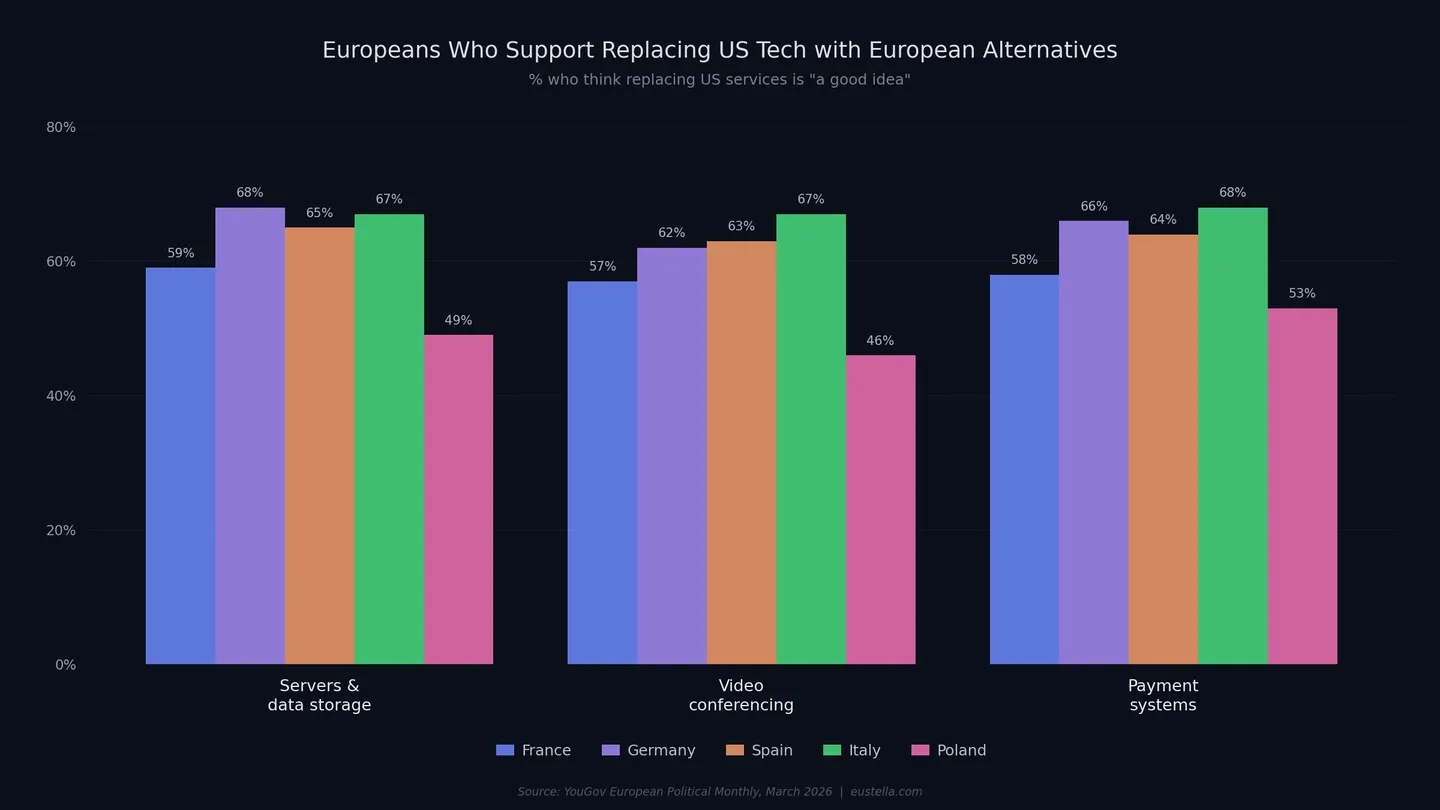
Around two-thirds of Europeans support replacing American technology services with European alternatives, according to a YouGov poll. The survey covered more than 1,000 respondents in each of five EU countries — France, Germany, Spain, Italy, and Poland — and was conducted between 6 and 16 March 2026.
The poll, reported by Tech Policy Press based on YouGov data, found that over 60 percent of respondents consider it a good idea to replace US services for data storage, video conferencing, and payment systems with European competitors. Specifically, 62 percent favoured switching data storage and payment services, while 59 percent backed moving away from American video conferencing providers like Zoom. Only 13 percent of participants called such a move a bad idea; another 25 percent were undecided.
Tensions Between Washington and Brussels
The poll comes against the backdrop of growing conflict between the EU and the United States over digital policy. US President Donald Trump claimed — without evidence — that Europe's online safety regulations restrict the free speech of Americans. In August 2025, he wrote on social media: "I will stand up for countries that attack our incredible American technology companies" — without naming the EU explicitly. He added: "Digital taxes, Digital Services Acts, and Digital Markets regulations are all designed to harm or discriminate against American technology." The European Commission rejected these allegations. It is conducting ongoing proceedings in the areas of online safety and competition against both US and Chinese technology companies.
Broad Support for European Alternatives
Support for switching ran across all categories surveyed. Across all five countries, 62 percent favoured replacing US data storage and payment systems; 59 percent backed switching away from US video conferencing solutions. Support was particularly strong in Italy and Germany, where 67 and 68 percent of respondents respectively said replacing servers and data storage was a good idea. France came in slightly lower at 59 percent, while Poland brought up the rear at around 50 percent. Only 13 percent of respondents overall rated a switch as a bad idea — a remarkable consensus across the EU's most populous member states.
Poland stood out as the only outlier. There, support hovered around the 50 percent mark across all digital services, and 38 percent of respondents had not yet formed an opinion — significantly more than in the other four countries. This high share of undecided respondents suggests that the debate over digital sovereignty has not yet reached the same intensity in Eastern Europe as in the West.
Germany Sceptical, France Optimistic
Despite broad support in principle, many Europeans doubt the feasibility. Across all five countries, 41 percent of respondents considered a switch unrealistic, while only 40 percent considered it realistic; 19 percent offered no opinion. Germany showed the strongest pessimism: 51 percent of German respondents — the highest figure of any country — called leaving US technology unrealistic. This is notable because Germany co-hosted a digital sovereignty conference with France late last year. At the same time, only 12 percent of Germans said such a switch was a bad idea — a contradiction that highlights the gap between aspiration and scepticism.
The Gap Between Desire and Reality
The French were the most optimistic: 45 percent considered a switch realistic, while only 32 percent called it unrealistic. Yet even in France, a significant gap exists between willingness and awareness. In January 2026, Paris announced plans to replace services such as Zoom and Microsoft Teams with a French video conferencing solution for government use by 2027 — partly to regain control over critical digital infrastructure. However, 89 percent of French respondents had heard little or nothing about these plans, despite the government's active promotion. Overall, only 11 percent of French participants said they were aware of the initiative.
Amid these tensions, the European Commission defended its right to regulate the digital single market. Spokesperson Paula Pinho told journalists: "It is the sovereign right of the EU and its member states to regulate economic activities on our territory that are compatible with our democratic values." French President Emmanuel Macron has been among the most vocal advocates for an independent European path in technology, including the development of homegrown artificial intelligence. The poll results show that growing frustration between transatlantic partners is increasingly reaching ordinary European citizens — even if the path from intention to implementation remains long.
A YouGov poll of respondents in France, Germany, Spain, Italy, and Poland shows that around 60 percent of Europeans support replacing American technology services with European alternatives. Yet only 40 percent consider the move realistic — a reflection of the growing transatlantic tensions in digital policy.
Source: Tech Policy Press — "Almost Two-Thirds of Europeans Back Replacing US Tech, Poll Finds", 26 March 2026.